Binocular Versus Telescope for Your First Astronomy Scope
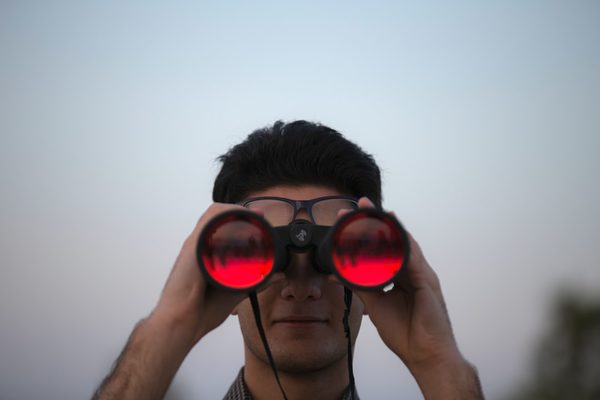
What if I told you that the best first scope for astronomy wasn’t a Schmidt Cassegrain or even a portable travel scope, but a pair of binoculars?
Crazy, right?
Actually, a binocular is a valuable addition to your astronomy toolkit, and most people are amazed at what they can see.
Why Binoculars?
A lot of people have a binocular at their disposal and never give it a second thought when it comes to looking at the heavens.
Did you know that Galileo’s first telescope only magnified by 3x? The scope he made most of his observations with was only 23x magnification, and with it he was able to see the phases of Venus, the moons of Jupiter, and lots of “hills and valleys” on the Moon.
There is so much to see with even a modest 7x binocular. A solid binocular is considered a must have by most astronomers, yet people new to the hobby disregard it in pursuit of magnification.
Magnification isn’t as important as the makers of cheap telescopes would have you believe.
What Can I See with Binoculars?
You aren’t going to be looking a Hubble images of the planets, for sure, but doing that requires specialized equipment. The Hubble is up in space and has a ten-foot objective mirror. You won’t be matching it with a backyard setup.
What binoculars do show you is a wide field of view that allows you to see larger nebulae and galaxies. Planets may show a disc shape but won’t resolve much detail. The moon will be magnified large enough to start picking out some of the details that you cannot see with the naked eye.
The best use of a binocular is finding objects that you can later aim your telescope at. Comets, Nebula, and other bright wispy objects that you can note for future study.
In fact, some objects look better in a bino than in your telescope. The Andromeda galaxy is nearly three times the size of the moon, and can be spotted under dark skies with the naked eye, though it requires some viewing skills.
At first glance with a binocular, you will be able to see the faint glow of the galaxy’s core, but with more practice, you can make out some of the banding on the spiral arms. These are things you simply won’t see with higher magnification.
A terrific place to start with telescope viewing is the Messier catalog. While this list has grown to over 100 objects, the brightest objects can be spotted with just a simple binocular, and knowing where to look will help you learn the night sky.
Why is Low Magnification Better?
It all comes down to something called exit pupil. A 7x50 or 8x50 binocular is setup to deliver a terrifically bright image because the magnification is matched to the size of the front lenses for the human eye.
At night, most people’s pupils will dilate to about 7mm, and you will get the brightest image by filling that whole pupil with the image from the scope. A 7x50 produces an exit pupil just over 7mm. If you were to use a 50mm scope at 50x magnification, the pupil shrinks to 1mm, and the view becomes incredibly dim, so dim that many nebulae and galaxies simply disappear from view.
I won’t get into exit pupil calculations in detail in this article, but it’s sufficient to understand that exit pupil gets larger as the objective element gets bigger, and smaller with more magnification.
In fact, at really high power, the exit pupil can be so tiny that it simply illuminates the back of your eyeball without showing you anything at all. The result is that you see an image of your own retina when you look in the scope!
Lower magnification also allows you to pan the vast star fields of the Milky Way with a panoramic view, made better by the fact that both eyes are open when using a bino.
Why do Astronomers Need Binoculars?
Astronomers use binoculars for spotting.
Especially when just getting started, it can be much easier to find deep space objects by panning with a binocular instead of looking at a star map. It’s also easiest to spot comets this way.
Binoculars can also be great on objects that your telescope simply isn’t good at showing you, like the Andromeda Galaxy. And the view is simply better on star fields with a quality binocular.
Objects also look different in binoculars than they do in a telescope. The Pleiades will show off some of its nebulosity in a binocular, but not in most telescopes. This is because the thin wisps are so faint that optimal exit pupil and maximum image brightness are necessities to observe them.
The Lagoon Nebula is a wonderful sight in binos, and it looks like a UFO. In a small scope it can be a little meh.
Several open clusters will sparkle and seem to glow in your binocular while they look like nothing more than a group of tiny stars through a scope. Still interesting, but not the same.
So Which Binocular Should I Get?
That is a fantastic question and it will take some time to answer. Check out our Binocular Best Picks if you are looking to get the best pair you can find.
For the budding astronomer learning the sky, a cheap pair will work to start with. Understand that the views won’t be as amazing as they can be, but you will definitely be able to find some targets, and you’ll have lots of practice with adjustments since cheap binoculars don’t function flawlessly.
Some general rules for a decent pair follow:
- BAK-4 or BK7 glass
- Avoid ruby red lenses
- Look for “fully-multicoated” on the packaging
- Get the biggest ratio of magnification to objective size you can find
- Keep the weight in mind, as binos get heavy during long viewing sessions
7x50 is almost universally agreed upon as the best size out there, but an 8x50 will work. Don’t go over 10x on the magnification, as the view will be shaky.
Check out our guide on choosing an astronomy binocular for more details.