Celestron 70mm Travel Telescope: A Great First Scope on a Budget
High quality scopes are expensive, but if you are just getting into astronomy you might not want to spend $2000 to try it out.
So what should you do? How can you make sure you get a quality investment for the money you have?
There are a few things you need to consider. First, whether a scope is best or if a binocular might be a better choice.
The next question is how often you will use the scope and where you plan to view from. If you live in a city surrounded by bright lights, you will only be able to see the brightest stars and planets no matter which scope you choose.
Even if you are in a rural area, light pollution from neighboring cities can be a problem on dimmer objects, especially with a starter scope.
That’s the first thing that makes this scope really shine for an astronomy newcomer.
A Travel Scope Will Follow You Anywhere
Travel scopes are handy not only for first-time astronomers, but can be a valuable asset as you continue to grow into the hobby.
Because of their compact size and light weight, you can take them just about anywhere, even on an airplane.
Setup is a snap, and you will be viewing the heavens in less than a minute.
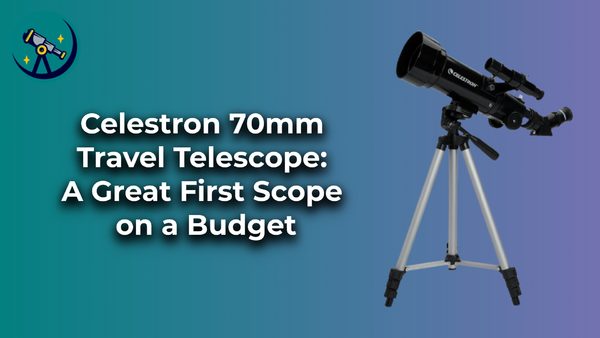
The Celestron 70mm Travel Scope comes with its own back pack, a couple of decent quality eyepieces, and a camera-style tripod mount that is quick to set up. No real experience required.
Magnification and Power
First off, magnification is one of the most overrated qualities that grabs peoples attention. In fact, searching for the highest magnification is a trap that newcomers consistently fall into when shopping for their first scope.
I’ll set the record straight right now, the more magnification, the more problems you will run into with a small scope. There are detailed explanations on this issue, but suffice to say that the eyepieces that come with this Celestron work quite well at 20x and 40x for getting bright views of the heavens.
Eyepieces are something that you will obtain along the way, so don’t fret too much on them for now. 40X is more than enough to see Saturn’s rings. Even though the planet will look tiny, there is much more to the heavens that Saturn.
Jupiter, similarly, will be fairly tiny at that range, but after viewing it several times you may be able to start picking out little stripes on the surface, and the moons will become more obvious to you as the four largest follow it through the sky (at first glance you might confuse them for little stars in the background).
What Else Will I See with a Celestron 70mm Travel Scope?
The moon is the most obvious target for new astronomers. It is filled with craters and there are several moon maps floating about to get you familiar with the more notable regions on the surface, of which all will be visible. Your closeup view will reveal more of the surface than you could imagine looking with your eyes, or even a binocular.
While 70mm is on the smaller side for deep sky viewing, there are several bright nebulae and other objects that are visible at different times of the year. The Messier List is a good place to start hunting once you learn your constellations.
The Great Nebula in Orion stands out in even the most humble scopes. It’s important to remember to start with low magnification, as it will give you the brightest image, and nebulae are ghostly in appearance anyway.
Most nebulae and galaxies appear not like pictures from Hubble, but wispy specters in the night sky, and that adds to their appear. Low magnification and long viewing times spread over several sessions will reveal more detail as your eyes adjust to seeing them. These “faint fuzzies” require their own skill set to master, but you can see the brightest of them with a 70mm scope or even a pair of binoculars.
Upgrades for a 70mm Travel Scope
While the scope provides a good start in astronomy, it won’t be long until you want to see more.
First off, the mount is a bit shaky, so something a little sturdier would be an improvement. A heavy duty camera tripod or any small astronomy class mount would be excellent with this light scope. Short of buying a tripod, you can also rig some weight to the legs of the included mount to make it a tad more stable.
While you shouldn’t push the magnification on this scope too high, a 2x or 3x Barlow lens would be a good upgrade for getting closer views of planets, pushing your 10mm eyepiece to 80x or 120x respectively.
You might think that a shorter eyepiece would be the way to go for more magnification, but I would not recommend it with this scope due to the very short tube. Even a high quality eyepiece in the 3mm-5mm range is going to give you blackouts while trying to see.
If you want eyepieces, I would recommend going for something lower magnification. In fact, get the longest focal length you can find, a 40mm is perfect for this scope. A 40mm eyepiece will provide you with panoramic views of the heavens and maximum light transmission for this scope.
One look at the Milky way through that eyepiece, and you will know what astronomy is all about, and why we all keep looking up.
It may seem counter-intuitive, I know, but a low magnification eyepiece should be a staple of your collection. Get the best one you can squeeze your budget for. Take care of it, and it will last you a lifetime and serve you well on every scope you buy in the future.
Another immediate concern would be the diagonal. We’ve never been fans of prism diagonals, but it does serve a purpose on this scope for terrestrial viewing, such as bird watching or at a shooting range. If you can spring for a 90 degree mirror, it would be an excellent addition to this scope and others you may buy in the future.
Conclusions
There isn’t a scope out there that can really do everything, but if you are new to astronomy, the Celestron 70mm Travel Scope is an affordable way to enter the hobby without dumping a truckload of cash or worse, testing out a department store scope to find out how bad they really are.
If you can spring to spend a little more, we have some good recommendations for other budget friendly starter scopes, but it would be unwise to settle for anything less than this 70mm offering from Celestron. It is by far the best budget scope out there for the price, and below this scope on the spectrum, scope makers start cutting far more corners than they should.