Celestron AstroMaster 90AZ Refractor Telescope Review: Who is This Scope For?
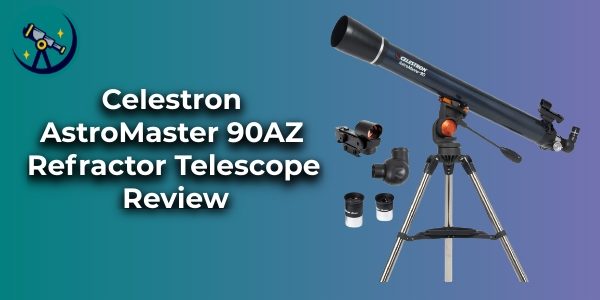
There are a lot of important considerations when choosing a first scope, or even a second.
But you needn’t be overwhelmed.
If you are looking for a first scope, then making sure you get a decent scope should be the primary objective.
By all means, you don’t need to spend a ton of cash to enjoy astronomy, but you do need to spend enough to avoid some of the junky scopes out there.
Celestron AstroMaster is a nice compromise.
TLDR:
A wonderful first scope that delivers good aperture and a long forgiving focal length. Perfect for the new astronomer or a youth, or just to test the celestial waters.
What’s Bad About the Celestron AstroMaster Scope
Every telescope is a compromise. Yes, even the big ones that cost thousands of dollars.
In the case of smaller and cheaper scopes, these trade-offs are more apparent.
The first thing I noticed about the scope was the tripod, something beginners rarely give much attention to, and second was the mounting. This isn’t a terribly sturdy rig, but for casual observing it is tolerable.
As you grow in astronomy, you will probably become more frustrated with mounting options because you want to spend more time viewing and less time fiddling. This mount is a small step up from a camera tripod, so expect a little shaking when you touch the tube or the focus knob.
Another thing to keep in mind is that you will have problems trying to look at targets directly overhead. Especially with a long scope, the mount becomes unbalanced, so make sure it doesn’t tip over.
The diagonal is a prism type that gives you erect views during the day, but scatters quite a bit of light at night, and even robs some of your aperture because it is stopped down.
That takes care of the bad, let’s look at some of the better points.
Is the Celestron AstroMaster 90AZ a Good Telescope?
The tube itself isn’t bad for this price point. The focuser could be better, but not without stacking a couple of hundred dollars onto the price tag.
A standard telescope mounting is attached to the scope, meaning that it will transfer easily to a better mount in the future without the need for extra equipment, such as scope rings.
The optical system is an achromat design, and with the long 1000mm focal length, this scope is designed primarily for magnification.
The included eyepieces are 10mm and 20mm Kellners which work really well and give long eye reliefs. It’s a dated design, but they are still terrific while keeping the cost down.
The coatings could be better, but you aren’t going to be chasing down dark nebulas with a 90mm scope, so it isn’t a worry. The skies you are under will be the biggest limiting factor.
At 90mm, you are getting a fair amount of aperture for a beginner scope. This guy is perfectly capable of hunting down most of the deep-sky objects in the Messier catalog. Most will look like fuzzy smudges, but detail can be made out quite well on the Orion Nebula under dark skies.
All in all, the tube isn’t half bad, and it’s super easy to upgrade to a better tripod later on when you have some extra cash.
Upgrades for the AstroMaster 90AZ
Especially if buying this as a first scope, the very first thing you might want to look at is eyepieces. A Celestron eyepiece kit would make a nice addition to the scope, but some nearly immediate things to add would be a low-power eyepiece and either a Barlow or a high-power eyepiece with good eye relief.
The mount will eventually become a little annoying. An Omni CG-4 offered by Celestron, or anything in this class of telescope mount, would be a huge upgrade, and you will be able to use it with other scopes as well. Note that a good mount will cost as much as a starter scope package, but the payoffs of having a stable platform are huge.
Those are the big ones, and I think you will find similar recommendations on any starter scope. So, all in all, not a bad choice for a first telescope.
Who is the AstroMaster 90AZ Telescope Made For?
Now the big question, is the AstroMaster 90 right for you?
In general, this is a terrific first scope for kids. If you have little ones that want to catch a glimpse of the sky and begin a future in astronomy, it’s a heck of a scope, and one they won’t bore with quickly, especially if they catch the DSO bug.
The length of the scope and the size of the primary optic makes this a pretty decent design for most of the beginner targets in astronomy. Begin exploring some nebulae and galaxies while training your eyes to tease bits of details out of the fuzzy blobs.
1000mm focal length is nearly ideal for planetary viewing. A 2500mm reflector might make a larger image, but a refractor always gives the better view because there is no central obstruction to degrade contrast. 1000mm also gives you enough range to get up to 200x magnification on planets, and the only piece of kit you need to add is a Barlow.
Just beware the shaky mount when boosting the magnification that high.
Achromatic scopes aren’t the highest optical quality, but they are an awesome blend of good viewing and minimal optical effects, especially in slower scopes like the AstroMaster, and they function quite well with Kellner eyepieces, so the combination is definitely a win.
If you are new to astronomy, this is a good scope. It’ll give you a sampler of every kind of heavenly object without a dedicated scope for only certain targets. It’s also easier to transport than a Newtonian reflector or a Dobsonian, so you can take it just about anywhere to find darker skies. It’s also has a much larger target ranger than smaller travel scopes, so it will show you more in every category.
The scope will grow with you. Good glass is good forever, and you will be able to grow your astronomy kit with this scope, and probably find yourself using it with better equipment, even after you have purchased other telescopes. It’s a pretty decent bargain.
Overall, the Celestron AstroMaster 90AZ Refractor Telescope is a great buy, and a good way to get a head start into astronomy, giving you great views of the moon, the planets, double stars, galaxies, nebulae, and more.