Choosing a Diagonal for Your Telescope
Does it really matter?
What’s all the fuss about dielectric diagonals and quartz glass?
Isn’t a diagonal just a mirror?
To the beginner who just purchased a telescope without a diagonal, or someone looking for a replacement, the world of diagonal telescope mirrors can be a bit...insane.
You will hear thoughts about the type of glass used, the different kinds of aluminum coatings, how the coatings are applied to the glass, and more.
The question presented is often one of whether all of this is just hot gas from a marketing supernova, or if there is a real difference between a $20 diagonal and one that costs hundreds.
We’ll help you sort through the details and figure out which diagonal is right for you.
Isn’t a Diagonal Just a Mirror?
As you might imagine, astronomy mirrors are a bit different than the vanity in your bathroom. In fact, they are closer in nature to mirrors produced before coated plate glass was a thing, where a metallic surface was flattened and then polished to a high degree.
If you study any common mirror carefully, you will notice that the glass side faces you, and a shiny coating is applied to the back. Light is transmitted through the glass and bounced off of the mirror surface.
Unfortunately, light passing through glass at an angle bends, which is why telescopes work in the first place.
So the real difference between a normal mirror and an astronomy mirror is that the coating is applied on top of a glass substrate. There is no glass between the shiny and the light you wish to bounce off of it.
Constructing mirrors this way makes the surface much more fragile, but it reduces false coloring and other optical effects.
Every astronomy mirror is created this way.
What is a Dielectric Star Diagonal?
The term dielectric gets a little more attention than it deserves in the astronomy community. Technically, most coatings applied to glass are applied dielectrically.
Dielectric is simply the addition of super-thin layers of coating material that is done in a very controlled way.
Instead of being painted on, the material is heated in a vacuum chamber and the charged steam that it makes will be attracted to an oppositely charged piece of glass and laid down in a very uniform fashion.
This is pretty much the gold-standard in thin film coatings.
With dielectric mirrors, there is a little more to it. The coatings are actually applied in a very precise thickness so that all reflections are recombined and the wave-forms interfere constructively, but let’s not fall too far down the physics rabbit hole.
The long and short of it is that dielectric mirrors, as they are called, can be more reflective than any other polished surface, with some multi-layer coatings achieving 1/1000th of a percent of loss, but be prepared to pay heavily for that kind of equipment.
Most dielectric star diagonals sold on the market advertise a 99% light transmission rate, and that’s pretty darn good for optics. It’s also something that your bathroom mirror will never accomplish.
Astronomy diagonals are typically set up to ensure that the mirror is dead straight in the middle of the optical path, or collimated. With diagonals, this isn’t too much of an issue, as the light cone is generally so small at that point, but being too far out may cause some issues in the eyepiece.
Is a Dielectric Star Diagonal Better Than a Regular Diagonal?
Contrary to popular opinion, this question is much more complicated than it seems.
You see, astronomy mirror diagonals have different qualities and not all of them depend on the coating.
Let me explain.
When you see bargain astronomy mirrors, either telescope mirrors or diagonals, they are generally made with cheaper materials. This means soda glass underneath the mirror coating. It means less layers of dielectric, and little to no surface coating to increase the durability.
But why is the glass important? Isn’t glass pretty much glass? Well, yeah, to a degree. There are actually dozens of different grades of glass.
Soda glass is cheap and easy to produce, but brittle and a bit softer than other kinds. Pyrex is strong and can handle temperature extremes very well. Fused quartz is a phenomenal glass that is super hard and doesn’t expand or contract much based on temperature. It’s also pretty strong.
The hardness determines how high of a polish the glass will accept. To that matter, part of the quality comes in how much polish the manufacturer decides to put on the glass as well. If they apply the same treatment that they would for soda glass when making a quartz mirror, then the material is effectively wasted on the manufacturing process, as it’ll be no better than the cheaper glass.
Then there are the coatings. Believe it or not, more is better, and also more expensive. It also means there are more chances for a mistake to ruin the piece, and thus the price goes up to account for that as well.
We must also consider what the manufacturer means when they say dielectric. Is it the process of thin film coating, or have they engineered that coating to have the best reflective qualities? Have they added a surface coating to protect it? Does that surface coating negate the layers beneath it?
Combine all of this together, and you have a mess of variables that ultimately leads you nowhere, so you just have to trust that quality optical companies are charging more for a higher quality piece of equipment, which is usually the case.
But don’t worry, you can still base your decision on something more tangible.
Quality vs Cost
At the end of the day, the secret sauce is to get the equipment that you need or want, and forget about the nitty gritty details.
Low cost diagonals are great for kids and star parties, where your personal viewing pleasure isn’t as important as having a piece of equipment that won’t leave you crying if it drops on the pavement or gets a scratch or smudge on it due to mishandling.
Run of the mill Dielectric Star Diagonals are aimed toward upgrades for scope kits. Generally the specs aren’t listed, but BK and BAK glass is better than soda lime, and quartz is the best, and these will sometimes be advertised as a feature. In general, they will give more light transmission than the cheap stuff, but may still scatter light depending on the polish and the coatings themselves.
High end Star Diagonals can seem nearly ridiculous. Let’s be clear, you won’t be seeing better light transmission with your eyes, but an astrophotography camera might show you the difference, as diagonals make a convenient way to extend the back-focus of your scope to accommodate a camera.
High end diagonals are generally also designed for the glass used, which means the highest polish that can be put on will, and only high-density glass will be used. It also means that they are willing to take on the expense of a tuned coating and protections for that coating, as well as ensuring that it shows great color with no distortion.
Recommendations for Star Diagonals
If you are on a truly tight budget and you need something to get you by, there is no disgrace in purchasing a lower cost diagonal like the SVBONY Star Diagonal. It’s not going to provide any kind of magical viewing experience, but on smaller scopes with other low-cost equipment, they just work. And it’s hard to beat the price.
For a little more money, you could also purchase a Celestron or Orion 90 degree diagonal and get the benefit of great customer support from a company that has been around longer. Remember, even if you upgrade later, these make great back-ups when other people will be looking through your telescope.
If you really want to go dielectric and up the quality meter on your viewing, then it’s hard to skip over the Orion Twist-Tight Dielectric Mirror Star Diagonal. Sturdy quality that you can trust. It is threaded for filters and also has internal baffles to boost contrast. There is also a 2-inch version with an included 1.25” adapter.
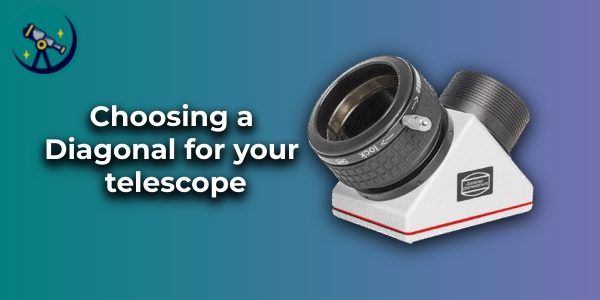
If you want an excellent diagonal for stellar viewing performance and the best options in the industry, the Baader Planetarium 2-Inch Clicklock Mirror Diagonal is one of the best value options in the business. It’s a little pricier, but well worth the investment, and in our opinion, one of the best out there for a 2-inch focuser. These are great for those looking to upgrade toward observatory-grade equipment.