Orion Q70 Wide-Field Telescope Eyepieces: Best 2” Eyepieces for the Money
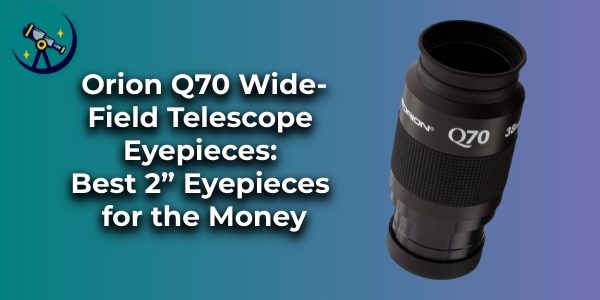
Thinking about some new accessories for your big Dobsonian telescope with the 2” focuser?
But perhaps you are worried about the price of eyepieces for a 2” tube.
We tested Orion’s Q70 line-up, and this is what we found.
TLDR:
The Q70 series is terrific for the money. Everyone should have at least one in their collection if they have a scope with a 2-inch focuser.
What is the difference between 1.25” and 2” eyepieces?
First off, why not stick to your 1.25” eyepiece collection? After all, when you buy a scope with a 2” focuser, it will usually come with an adapter for 1.25” eyepieces. What’s the fuss about?
It turns out, a lot. Or nothing. It depends on what you are looking at.
I’ll be perfectly honest, if your only goal is high magnification on planets, a 2” eyepiece probably isn’t going to be showing you any more than a standard barrel size.
However, if you are going for wide, sweeping views of the Milky Way and glamorous framing for larger DSOs, a 2” eyepiece will generally give you a much wider field of view, because the stop is physically larger than a 1.25” barrel will ever accommodate.
So, main difference? The apparent field of view (AFOV) can be much larger on a 2” eyepiece. That said, the difference is only really clear at longer focal lengths. So, wide angle views at low magnification is where the 2” party is at.
There is one more advantage, and that is the more comfortable viewing provided by a huge occular instead of a peep hole. This is a difference at the shorter end of the focal length spectrum.
In general, 2” eyepieces are just nicer to look through, but they can be quite expensive.
The Price of 2” Eyepieces
Two-inch eyepieces are a little pricier than comparable 1.25 variants, but we all know that those can become quite expensive as well.
I think the price barrier comes from people looking into the most expensive options out there first, like the Televue Ethos eyepieces that can run up near $1000.
The Q70s first caught my attention because they were in the more moderate $100 range.
Are they Televues? No.
Are they pretty darn good for the price? You bet’cha. Here’s why.
Fully Multi-Coated Glass
Each of the five glass elements in these eyepieces are coated on both sides with anti-reflection coatings for maximum light transmission. There is a lot to be said about the benefits of glass coatings, but suffice to say that this is the industry standard when you want the most light to reach your eye.
Orion manages to do this at a price that immediately sets them apart from the competition.
Parfocal
The Q70 lenses are designed to work together, and they are set up where you can hot swap them while viewing with little to no need for focus adjustment.
That said, there is no truly parfocal experience, and every eyepiece will be slightly different depending on how many turns on this thread or that while assembling them at the factory, but at the very least you should have an image that’s easy to focus after swapping without the need to run your focuser out to some extreme length to reacquire your target.
In our experience, they swap quite nicely. Since we use these mostly for panning and big DSOs, the focus seems to work perfectly, as opposed to high-magnification planetary eyepieces that can be a bit more fickle.
Warranty
Orion carries warranties on most of their equipment. If you have any problem at all, just call them and they will make it right. They’ve been very good to us over the years and we can back them up on this.
Truly Wide-Field Experience
70 degrees AFOV on a 26mm lens is a truly eye-opening experience. The closest eyepiece in the 1.25” barrel size is probably the BST Flat Field, which weighs in at 53 degrees. You are getting 30% more field of view than you would see with any 1.25” eyepiece.

Caution on Fast Scopes
Not all is wonderful in the eyepiece world, and at this price there will be some trade-offs.
In an f/5 or faster scope, the 26mm lens suffers some pretty severe astigmatism issues around the edges. For new viewers or people focused on the center of view, this might not be an issue, but it does detract a bit from the experience.
Obviously, APO scopes can correct this to some degree, but even so, f/5 or f/4 is just too much angle for the Q70 lenses to handle, and especially on the short one, they start having problems.
The 38mm Orion Q70 is a treat, however. The longer focal length arrests the optical problems, and while it can’t completely be eliminated on fast scopes, the view through my 8” Dob is absolutely stunning in this eyepiece.
I’m so awed when peering into the Sagittarius star cloud that I fail to notice any weirdness by the edge of the field, and it gives a whole new perspective on the Lagoon nebula.
Eye Relief
This is where 2” eyepieces really shine, and the Q70s are no different. The effective eye relief zone is huge on these guys. It almost feels like putting your eye into some kind of portal to the depths of space. If you haven’t seen what a good 2” ocular can do, this is a great way to experience it.
No squinting needed.
Conclusion
The lenses run $120 or less usually (depending on the focal length), and compared to the $700 Televue they still do a pretty decent job. I’m not saying they are perfect, but they are definitely well worth the money, when you can buy several sets for the price of one eyepiece. They blow the Orion DeepView eyepieces (slightly cheaper) out of the water.
The Q70 eyepieces are also staggered well at 26, 32, and 38mm. With the addition of a 2” Barlow, you would also get 13mm, 16mm, and 19mm respectively, and that’s plenty of zooming power for smaller targets. A Barlow will also flatten the image and take care of coma problems, so a 1.5x can be used for big views with less edge distortion.
We recommend an Orion Q70 38mm for anyone with a 2” focuser. The views are well worth the cost. If you have a slower scope, then the Orion Q70 32mm is a good choice at f/6, but reserve the Orion Q70 26mm for f/8 and longer scopes, unless you plan on using it with a Barlow lens.