Orion SkyQuest XT8 Dobsonian Classic Telescope: Best Beginner Scope
Looking for a serious telescope for observing, but don’t want to spend thousands of dollars?
The XT8 is a high quality instrument that won’t break the budget.
At less than $500, it is the recommendation for newbies from many astronomers, and here’s why.
TLDR:
An 8" Dobson will serve well in just about every category, and for the price range, you won't find a more versatile scope and mount combination out there anywhere.
Best Bang for the Buck
Aperture is king when it comes to telescopes, and the light bucket design by popularized by John Dobson in 1965 is probably the most affordable way to stuff a lot of aperture into a convenient package at a low price that will ever be devised.
Based on the Newtonian concept, the Dobsonian telescope is, in fact, a Newtonian reflector. The largest difference that sets it apart is the mount. Instead of plopping a large tube on a massive tripod and requiring a step ladder to see through it when pointed vertically, the low to ground mount keeps everything right where you need it.
The box at the bottom is a simple altitude-azimuth mount constructed from simple materials that can be sourced for a low cost. The tube itself isn’t that different from other scopes, but is kept simply by a single axis mounting system that drops straight onto the dob mount.
All of this means that you save money. A high-quality mirror and focuser can be installed without fuss, and that is where your money is going, straight into the optics.
Other designs rack up the manufacturing price with mounts that are still shaky. As cheaply as Dobsonian mounts can be made, they are very sturdy, using the weight of the scope to add stability, rather than take from it.
It’s quite ingenious, and the result is the most aperture for the lowest cost. Some of the largest telescopes on earth work on the same principal of a pivoting ground mount, allowing huge mirrors to be used.
As Much Aperture as you can Handle
There are so many models available when it comes to Dobsonian telescopes. Everything from minuscule 4-inch scopes to giant 3-foot mirrors are yours for the taking.
Of course, the price goes up as the mirror diameter increases, but before hitting your budget threshold, most people encounter another issue. The size of these things can get big enough that you simply won’t want to use them.
The weight of the Orion XT8 seems to be the sweet spot for most people. It comes in right at 41 pounds, meaning that it can be lugged out of the garage quite easily for backyard viewing, and it’s also one of the largest scopes that can be easily transported in a car.
You might want to use the back seat rather than the trunk, though.
The tube and mount weigh almost the same, about twenty pounds each.
It is a little clumsy to handle, but the overall weight is about the same as a five-gallon bucket filled with water.
Ease of Use
While dob mounts are easy enough to understand under a dark sky with eyepieces in hand, there are a couple of drawbacks inherent to any Newtonian telescope.
The first is collimation. Most refractors are assembled in such a way that you rarely need to worry about the alignment of the optical elements. Such is not the case with a newt.
While there is nothing difficult about collimation, it can be scary for someone new to the hobby. This video explains the process quite simply for the uninitiated.
Other than that, they are a breeze, and as easy to use as any other altitude-azimuth configuration. Just point it at the target and look through the eyepiece.
Features
The XT8 comes with a 2” Crayford focuser, allowing for larger eyepieces that provide sweeping views of the heavens and very large fields of view. You can also use regular 1.25” eyepieces with a simple adapter that is included in the kit.
The XT8 kit comes with a 25mm Sirius Plossl eyepiece and an EZ Fidner reflex site. I’m not a fan of the reflex, I’ll be honest. It’s a little cheap, but it does certainly work. I swapped mine out for a 30mm finder scope that works better for me.
The eyepiece matches up with the scope to provide a 48x magnification with a 4.2mm exit pupil.
I’m pretty sure Orion has kept the accessories down to keep the price down while knowing that most who buy this scope will already have some kit, and they don’t need another set of Sirius eyepieces.
Quality
I’ve owned my XT8 for over a decade now, and it is still serving me well. I’ve made several upgrades so that I can mount it to my heavy duty tripod for astro-photography service and sky-following capabilities, but have done nothing at all to the optical components. It’s a solid piece of equipment.
The scope does come with a one-year warranty from Orion, so if there is some mishap during shipping and something isn’t right, just contact them and let them know. They’re easy to work with.
The focuser isn’t the best in the world. It is a Crayford, but it isn't the most buttery smooth tube of wonderful that some Crayfords can be. I’ve had no issues finding focus and have located many a faint object, but it does sometimes annoy me a little when I'm trying to photograph planets with my big tube. This is probably the only part of this scope keeping it from being perfect.
The View
With a 203mm primary mirror, a lot of stuff that is invisible to other scopes suddenly appears in view. Even under moderate skies, this scope provides a lot of contrast and absolutely wonderful views of the whole Messier catalog.
Where it really shines is at a dark site. Since it isn’t too tough to move, you can take it places you might never drag an 18-inch scope out to. If you have a local dark site, or are willing to travel, you are in for a treat.
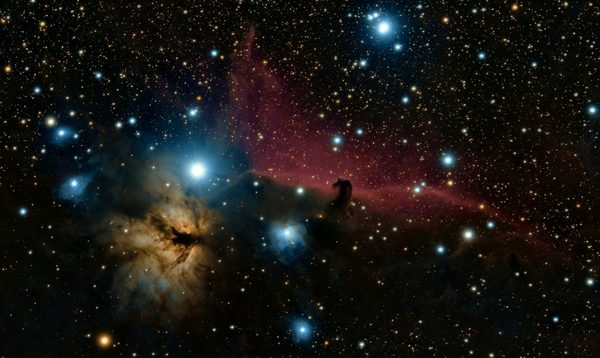
8 inches is considered the minimum by most for viewing the Horsehead nebula, as well as many other deep-sky objects. Smaller scopes simply cannot deliver the amount of light necessary to tease these ghostly DSOs away from the background. In short, you can see all the sights.
I’ve even spotted quasar 3C 273 in mine, from a suburban driveway! It wasn’t much more than a tiny dot, but realizing that light that has been traveling for 2 billion years just bounced off your retina is enough to make anyone feel a bit awed. That’s 1000 times further away than the Andromeda galaxy!
Accessories You Might Consider
Upgrade the finder scope. It’s pretty easy to plop a Telerad on there or any other quality finder you might rip off a smaller scope. Not a huge deal, but it will make star-hopping a bit easier.
A wide-view eyepiece should be a must-have with this scope. Mine is a 38mm Orion Q70, and it is my personal favorite budget 2-inch eyepiece. I also have a narrow band filter for when I’m closer to city lights. This scope seems to be made for panning the Milky Way, and the views are heavenly.
If you like, you can get a little carried away with magnification. With the laws of physics limiting you to 400x, it’s likely the upper atmosphere will cause more problems at high magnification than the scope will, so go nuts. A Barlow lens and a 6mm eyepiece can push this scope to the limit.
Conclusion
You really can’t go wrong with the XT8, unless it’s just too much weight for you to lug around. I recommend going to a local star party if you think it will be an issue. It does disassemble into 2 20lb components though, and most people shouldn’t have a problem carrying it or setting it up.
It is quite simply, the most aperture for the money, and the most seeing power available for the price. Bigger scopes get heavy and expensive quickly, and smaller scopes won’t let you see as much. For many in the astronomy community, us included, the Orion SkyQuest XT8 strikes a perfect balance when you want one scope that will do it all.