Orion StarBlast Astro 4.5 Reflector Telescope Review
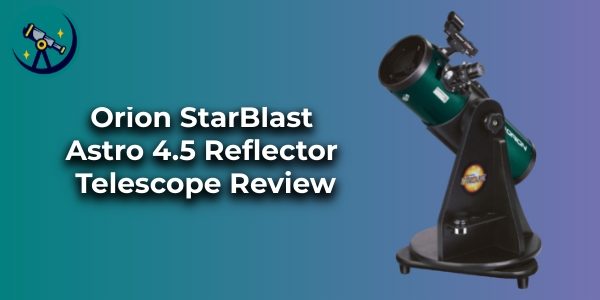
I remember in my younger days paging through one of those scientific catalogs and spotting “the perfect telescope for beginners” in an ad. It was a rather large diameter tube mounted in a table-top configuration, and it captured the imagination of not only myself, but my whole family.
Apparently, the design did more than that, and now these table-top reflectors can be found just about everywhere. The design has been tried and tested, but are they really worth all the buzz?
Let’s find out.
TLDR:
The Orion StarBlast is a solid beginner scope for kids or really anyone dabbling in astronomy for the first time, but we wouldn't recommend it for anyone who wants to make a serious voyage into astronomy.
If you have a specific niche to fill, sadly, this won’t contribute much to your collection.
That said, there is a special place in our heart for this as a backup travel scope that can be kept in the trunk or backseat for guerrilla astronomy sessions.
The Venerable Tabletop Telescope
Of all the scopes out there in this category, we decided to try out a tabletop reflector from Orion. The StarBlast has been a popular model for a few years, but since we aren’t generally new to astronomy around here, we didn’t have one on hand.
The price is quite reasonable, and we feel that this model is a good test of this kind of scope. It comes with a standard rack-and-pinion focuser, a couple of Kellner lenses, a four-inch diameter tube, and an actual parabolic mirror, which is really nice for a scope in this price range, especially one targeted at beginners.
TLDR:
First Impressions
The scope is tiny. Four inches in diameter is a little bit larger than a standard travel refracting telescope, but honestly doesn’t take full advantage of the lower cost of mirrors. The tube is only 18 inches long, which is quite small.
We got the little guy collimated quickly during the day and it was ready to take out that night. The action seemed smooth in both azimuth and inclination, and the focuser is definitely usable.
Smooth Bearings and Smooth Scanning
Despite the price, the PTFE bearings between the mount and the telescope work surprisingly well. Slewing the scope from one point to the next in the sky was easy. We had endless fun panning the Milky Way and checking out the Orion Nebula.
Magnification and Eyepieces
The standard 1.25” focuser works well for this scope. The gears meshed well and we didn’t have much trouble focusing, but with the short length of this scope, focus isn’t too tricky as the magnification is generally quite low.
The scope comes with a couple of Kellner eyepieces. This might raise an eyebrow for some, but with really fast scopes like this, the budget minded person is well to consider these over a standard Plossl eyepiece. They generally handle the speed a little better without opting for tier 2 eyepieces or better, which can end up costing more than this whole scope.
The included eyepieces have focal lengths of 17mm and 6mm. Paired with the 450mm tube, this gives magnifications of 26.5x and 75x, respectively. And to be honest, this is a good range for this little telescope.
The downside to the 6mm is that the peep hole in the top is tiny, and the short focal length coupled with this makes it a little tricky to use. It doesn’t have blackouts like widefield eyepieces, but it can crane the neck a little to look through.
All in all, I think I speak for all of us here when I say that a 12mm and a Barlow would have been nicer, but it’s hard to ask too much from a scope in this price range.
The Mirror
The scope itself is quite magnificent, and the primary reason for that is the primary mirror.
These small scopes often come with spherical mirrors, which are cheaper to grind. The biggest issue with that shape is that incoming light doesn’t all focus at the exact same point, which in turn puts more work on the eyepiece and your patience.
While I wouldn’t call a spherical mirror a hobby killer, there are many who would. The blurry images just aren’t worth the trouble, even for some of my fellow astronomyscopes people.
Orion has crafted a parabolic mirror for this scope, and that is one thing I love about this brand. They always focus on the optics and the view first, leaving others to dabble in add-ons like smartphone mounts.
The views look terrific because of this. At the end of the test session I even tried out some of my more expensive eyepieces, and they did wonderful things with this scope, even pushing the magnification far enough for me to do some proper planetary viewing.
What Can You See With the StarBlast?
Okay, onto the nuts and potatoes. This scope, while wonderful for beginners to get a sampling of what’s up there in the sky by taking a closer look, is not particularly fantastic at any one kind of astronomy. It’s more of a jack of all trades.
The 114mm mirror does have some good light gathering. The secondary mirror only blocks a little light from getting in, about 10% of it. It’s comparable to a 4.25” refractor, which is pretty large for a beginner. Unfortunately, if you are looking for deep sky as your primary viewing targets, you will be limited.
It should still collect the whole Messier catalog, so there is still tons to be discovered for the newcomer, but if you want to collect a lot of light, stepping up to a 6 or 8 inch dob might be the way to go.
Planetary viewing isn’t going to be great. Even with the included eyepieces, you can see the rings of Saturn and some banding on Jupiter, but don’t expect too much. The short focal length of this scope really limits it from getting anywhere near its theoretical 200+x magnification range, as you would need a super short focal length eyepiece or a whole lot of Barlow lens, or both.
The low power lens (the 17mm) gives a decent exit pupil of 4.3, so you really can’t take the scope to the limit of its wide angle capability with the included gear. A 25 or 28mm eyepiece will give optimal light gathering for this scope and terrifically wide fields of view filled with stars. If you are thinking of an upgrade, that would be a good one.
Unfortunately, you can’t expect crisp edge of field views with most budget eyepieces, so that does dampen the vista as the stars turn to jelly beans near the edge of a 25mm Plossl.
The Mount
Just as solid as any Dobsonian in our collection, this mini-dob is super sturdy and easy to point with the included reflex sight. You can bump and nudge it to keep your target in the field of view, just like a bigger dob, and due to the small size it never really feels unbalanced.
There isn’t much to say here, it’s simply terrific. Larger scopes will often come on shaky mounts, and this is one shortcoming the Orion StarBlast doesn’t have. It makes viewing super simple, even with the tiny 6mm eyepiece.
Conclusion
The Orion StarBlast isn’t a scope for everyone, but despite its shortcomings, it can be a wonderful scope for kids or anyone who is totally new to astronomy who wants a good scope on a low budget.
If you aren’t sure what type of astronomy you might be interested in, this is a good starting point. It won’t do anything the best, but it will cover a lot of ground to give the new astronomer a taste of what’s out there.
For deep sky viewing, all or most of the Messier list shouldn’t be a problem if your skies are dark and the air is clear. Four and a half inches is a good bit of aperture, and more than Messier himself had access to for a lot of his viewing. Modern mirrors are also much better than his equipment was.
For planetary viewing, I cannot recommend enough getting a good quality Barlow lens. While we spend a lot of time telling newcomers to turn back the magnification bug, it is justified here. I simple 2x Barlow and possibly some better eyepieces will make this scope very capable for planetary viewing.
Double stars, comets, galaxies, and the Moon are easy to start finding in this scope, and it’s a great learning platform if you are looking to get started. It’s also super easy to transport to a dark site, just don’t forget to take something along to set it on.