Viewing The Andromeda Galaxy (M31)
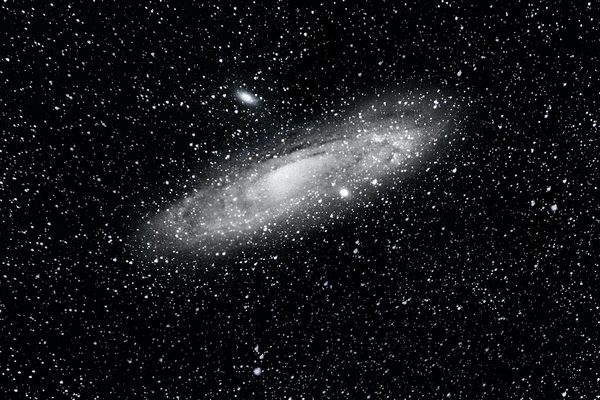
When looking up at the night sky from a dark location, just off the northern trailing edge of the Milky Way, there is a sight that is truly astonishing and has been a wonder of the cosmos since the beginning of astronomy.
An entire galaxy, separate from our own, and millions of light-years away, yet bright enough to be seen without the aid of a telescope or any equipment other than the human eye.
As far as the highlights of this galaxy’s galactic importance, here are some interesting factoids before we go out fuzzy hunting for Andromeda.
- The Andromeda Galaxy was first described by the Persian astronomer Abd al-Rahman al-Sufi.
- The Andromeda Galaxy is bigger than the Milky Way, and on a collision course with us.
- The study of Andromeda was a keynote in the Great Debate about the size of the universe and our place in it. A star inside the galaxy actually settled that debate five years later.
Finding the Andromeda Galaxy
In the night sky, under dark conditions, the Andromeda Galaxy shines so brightly that it can be detected as a smudge in the northern sky, but finding it might prove a little tricky. There are a couple of methods depending on the constellations you are most familiar with.
If you know where to look for the great square of Pegasus, and consequently the trailing arm that we call Andromeda, then it’s quite easy to find. The brightest star on the arm, Mirach, marks a T-intersection with two offset stars that are part of Andromeda. These essentially lead the way to the galaxy. Simply follow the two trailing stars and look right. If you use this method and you have really dark skies, you can also go about the same distance to the other side of Mirach and find the Triangulum Galaxy.
Another popular way to find the Andromeda Galaxy is by way of Cassiopeia, a more familiar constellation for those just learning their way around. The W shape of the constellation can be divided into two triangles from the central point, one more prominent than the other.
Follow the pointer triangle as if it were an arrowhead, and it will direct you almost perfectly to Mirach. Then simply backtrack as before, following two other bright stars to Andromeda.
Here’s a screenshot from Stellarium that might make things easier:

It’s best to look for the Andromeda Galaxy from early summer until the end of January, as it will be up during the earlier portions of the night. If you are in far Northern latitudes, you can see it anytime that the sky is dark, as it is fairly close to the North Star.
Naked Eye Viewing of the Andromeda Galaxy
Naked eye viewing of Andromeda requires clear, dark skies and a moonless night. Averted Vision will help. Find Mirach and let your eyes wander toward the prize.
Depending on how good your viewing site is, you should be able to detect the galaxy as a fuzzy smudge between Andromeda and Cassiopeia. If you can see the milky way passing through Cassiopeia, then you might be able to see it while looking directly at it, but otherwise, you will need to look away from its exact position a little.
Naked eye viewing won’t reveal anything spectacular. It’s highly unlikely that you will see much more than a bright core with a bit of glow around it, but it might blow your mind to think that you are looking at something 2.5 million light-years away without any special equipment.
If it is particularly bright, you might even try looking for another galactic neighbor of ours, the Triangulum Galaxy. Some sources will tell you that the naked eye can’t see the wonderful whirlpool that is about 3 million light-years away, but they would be criticized by those of us who have seen it. It is a much tougher target though, and even with the best-averted vision will be hard to detect as anything more than a slightly brighter patch of sky about equal distance from Mirach on the other side.
Seeing the Andromeda Galaxy with Binoculars
Some will tell you that the best tool for viewing the expanse of the Andromeda galaxy is a good pair of binoculars, and we believe they are correct. The span of the spiral arms is about three times the size of the moon, and the only way to really fit the whole galaxy into the frame is by looking at low magnification.
Obviously, a lot of aperture is still a good thing. A pair of 120mm astronomy binoculars might cost a pretty penny, but they could be the best tool for trying to see the dusty lanes of the spiral arms. Just be sure to use a mount as they are quite heavy.
There aren’t many experiences quite like taking in the whole of the Andromeda Galaxy, and it makes a wonderful first target if you are shooting for your Binocular Messier Certification. You can snatch up M110 and M32 while you are at it, in the same frame!
Even with your trusty 7x50 Binos, the Andromeda galaxy can provide hours of viewing and is great practice for observing other faint fuzzies. It may take some time to pick out those dusty lanes, but once you can see them, it adds more excitement to your enjoyment of the night sky.
The Andromeda Galaxy through the Telescope
Generally speaking, this isn’t a terrific target for a first-time telescope user who is striving to strain the magnification potential of their scope.
A sky filter and a long focal length eyepiece are critical. Getting the lowest magnification from your scope is sometimes the only way to see anything.
I still remember as a boy trying to zoom in on Andromeda because I couldn’t see the image on the cover of my Boy Scout merit badge guide book, but with each step up in magnification, my chances grew slimmer, and I really had no advice to turn to at the time.
It’s important to remember that the galaxy is big. Very big. But one advantage to a bit more magnification, say in the 40-80x range, is that you can push the bright central core of the galaxy out of the frame for better dark adaptation to attempt picking out cloud bands. Some have success with this strategy, and some don’t. It depends on your eyes and your scope.
If you want to see the whole galaxy at once, you will need to limit your magnification to 20-40x, depending on the AFOV of the eyepiece, and that is really the best way to view the Andromeda Galaxy.
There is one practical upshot to this. A short tube scope like the Orion ST80 can make that magnification range easily, even with medium eyepieces.
Of course, don’t expect Hubble images from your telescope, unless you are doing some pretty serious astrophotography. This snapshot from Stellarium is probably representative of what you might see if your skills are up and you have good viewing conditions.

Technical Information About the Andromeda Galaxy
Andromeda is one of our close galactic neighbors, but not the only one. The Magellanic clouds are much closer and can be seen from the southern hemisphere. These are galaxies that orbit our own, much like M32 and M110 orbit the Andromeda galaxy.
The Andromeda galaxy is a spiral galaxy that, apart from size, is incredibly similar to the Milky Way galaxy that we live in. Thus, looking out toward Andromeda is much like looking into a giant cosmic mirror. We can learn much about our own home by studying our galactic sister.
The Andromeda galaxy is the largest galaxy in the Local Group, which includes our own Milky Way, the Triangulum galaxy, and other small galaxies that are hardly noteworthy, at least to the amateur astronomer.
The galaxy is so close to us that individual stars can be detected within by massive telescopes, and several novas have been observed within. It played a pivotal role in the Great Debate of 1920, and observations of Andromeda finally concluded that some of the “nebulae” in the sky were in fact their own “island universes” outside of our own galaxy, after decades of arguments and theories about the nature and size of the universe.
The Andromeda Galaxy is still making headlines, even today. Our observations more recently have revealed a Stellar Halo around the galaxy, and it is believed that the Milky way has one as well. This not only increases the “size” of the galaxy but could also account for more than 10% of a galaxy’s total mass. This is still an emerging science, so expect these numbers to fluctuate.
The disk of the Andromeda Galaxy is also warped a bit, with some “rings” orbiting the core at a different inclination than other areas. It’s a curious anomaly and one that reveals how much we still have to learn about galaxies, even our own.
We learn more and more all the time, and the Andromeda galaxy gives us a lot to look at. From black holes to tiny microquasars, and even an exoplanet candidate have been discovered or theorized from the wonderful views this galaxy provides us.
The Andromeda Galaxy is a host of science waiting to be discovered, and discoveries have even been made by amateurs. It may look like a fuzzy smudge, but it could be the most important Deep Space Object in all of the night sky for what it can teach us.