Viewing The Great Nebula in Orion
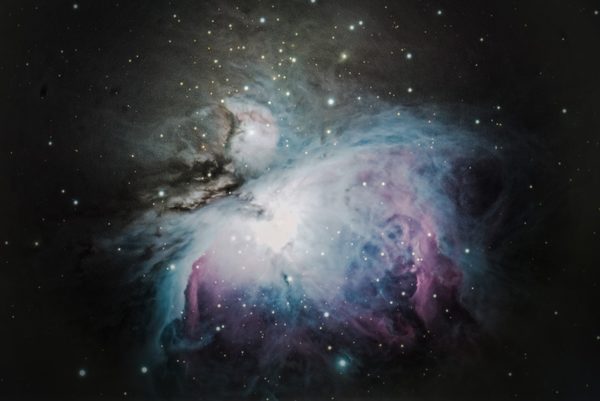
One of the finest objects in the night sky for deep sky observers is the Orion Nebula, without question.
You can see this wonderful nebula even with the naked eye, and it is visible in the northern hemisphere during the colder months, usually from late fall until late spring. From December until March, Orion is highest in the sky after dark and this makes winter the ideal season for viewing the nebula and other wonders hidden in the great hunter.
Learning the Constellation Orion
The landmark of the great hunter is one of the easiest constellations to see in the night sky. The primary stars making up the shoulders and knees are very bright, and the three belt stars are quite visible as well. Even under city skies, it can be picked out of the background sky easily.
Though it tracks from east to west, it travels through the southern half of the sky quite far from the horizon in most northern latitudes, following the celestial equator. Once you become familiar with the basic shape, it will be easy to come back to it again and again.
The layout of the stars is so memorable, that some think pyramids and cities in ancient Egypt were laid out to reflect the shape of Orion.
This is what the stars look like to the unaided eye
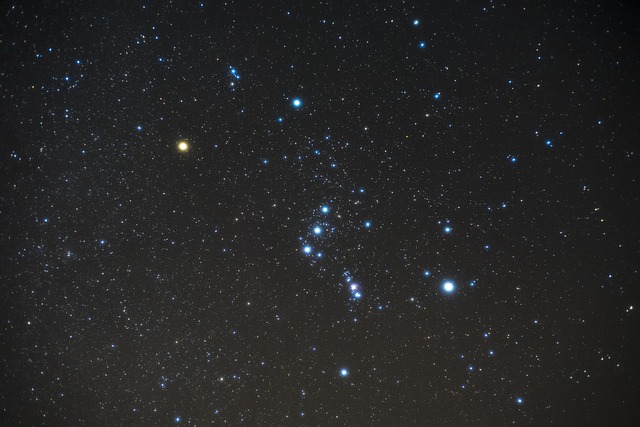
Look for the hourglass pattern and you will know that you are in the right place. The three stars at the center for Orion’s Belt, and the three below it form his knife or sword.

Once you can spot the constellation, keep looking. Something is a bit off about that central star on the sword. It isn’t a star at all, but rather a very bright nebula. This is the Great Nebula in Orion, or Messier42, and its remarkable brightness is one of the primary qualities that make it so great.
Naked Eye Viewing of the Orion Nebula
To the naked eye, you won’t be able to make out much detail, but it is a great target to practice averted vision on because it is so easy to see. Once you get it down here, you can turn toward Andromeda or nearly any of the brighter clusters on the Messier list and pick them out with just your eyes.
Look just to the right or left of it, and notice how much it grows not only in size but in brightness. The scope of the nebula is quite large, much more than the little fuzzy star might lead you to believe.
Seeing the Orion Nebula with Binoculars
One of the best objects to look at through binos has to be M42. It’s plenty bright, so if you have even recently dark skies away from bright city lights you will be able to detect nebulosity with a modest pair of 8x50 or 10x50 binoculars, even if they aren’t the best glass.
Detecting nebulosity and developing the patience for observing DSOs (Deep Sky Objects) is a skill that your eye learns over time through practice, and the Orion Nebula is a great place to start.
With the right skies and good eyes, you will be able to see the major bands stretching from the nebula quite easily, and might even be able to make out most of the ring. Some astronomers see even more, detecting little hints of fibrous tendrils, and the comma-shaped appearance of the nearby M43.
Looking at Orion through the Telescope
The bigger the aperture, the better, as with all DSOs.
But the Orion Nebula requires nothing more than a two-inch toy scope to be seen well, and it is so bright that it will take magnification quite readily, rather more like a galaxy than other nebulae that thin out and lose contrast under high magnification.
The Trapezium cluster at the heart of the Great Nebula is a viewing pleasure all its own, as many binaries can be split, and then again. The more magnification applied, the more you will see in this wonderful star nursery.
While no scope will feed you the wonderful false-color collaborations of the Hubble and experienced astrophotographers, there is much detail and even a little color to be gained from looking through a high-quality instrument.
These are the reasons that many astronomers, myself included, keep coming back to M42 again and again. It’s like Saturn with planetary viewing, it simply remains a wonderful gem in the night sky that can be seen quite often without losing any of its luster.
Technical Information About the Great Nebula in Orion
The Great Nebula in Orion is the closest region of star formation to our solar system, accounting for its apparent brightness. Its mass is estimated at 2000 times that of the sun and has an estimated size of 24light-years from one side to the other.
Historically and recently, the Orion Nebula is a sort of test tube for astronomers. It showcases the various stages of star formation and at only about 1300 light-years distance, we can study the nebula in immense detail.
In the early 20th century, a new suspected element called nebulium was promoted as a possible source of the greenish hue that we see when looking upon it through the scope, though atomic physics replaced that theory in time.
Everything from star birth to star death can be observed in this cloud of gas, and it’s believed by some that it’s also home to a black hole more than 100 times the mass of the sun. If confirmed, this would be the closest black hole observed to our Sun.
The more we study the Orion Nebula, the more we learn about the life cycle of stars and the vastness of the universe. At the same time, it’s not some hidden treasure reserved only for scientists with millions of dollars of equipment, but shining brightly in the sky for all of us to see, study, and wonder about.